

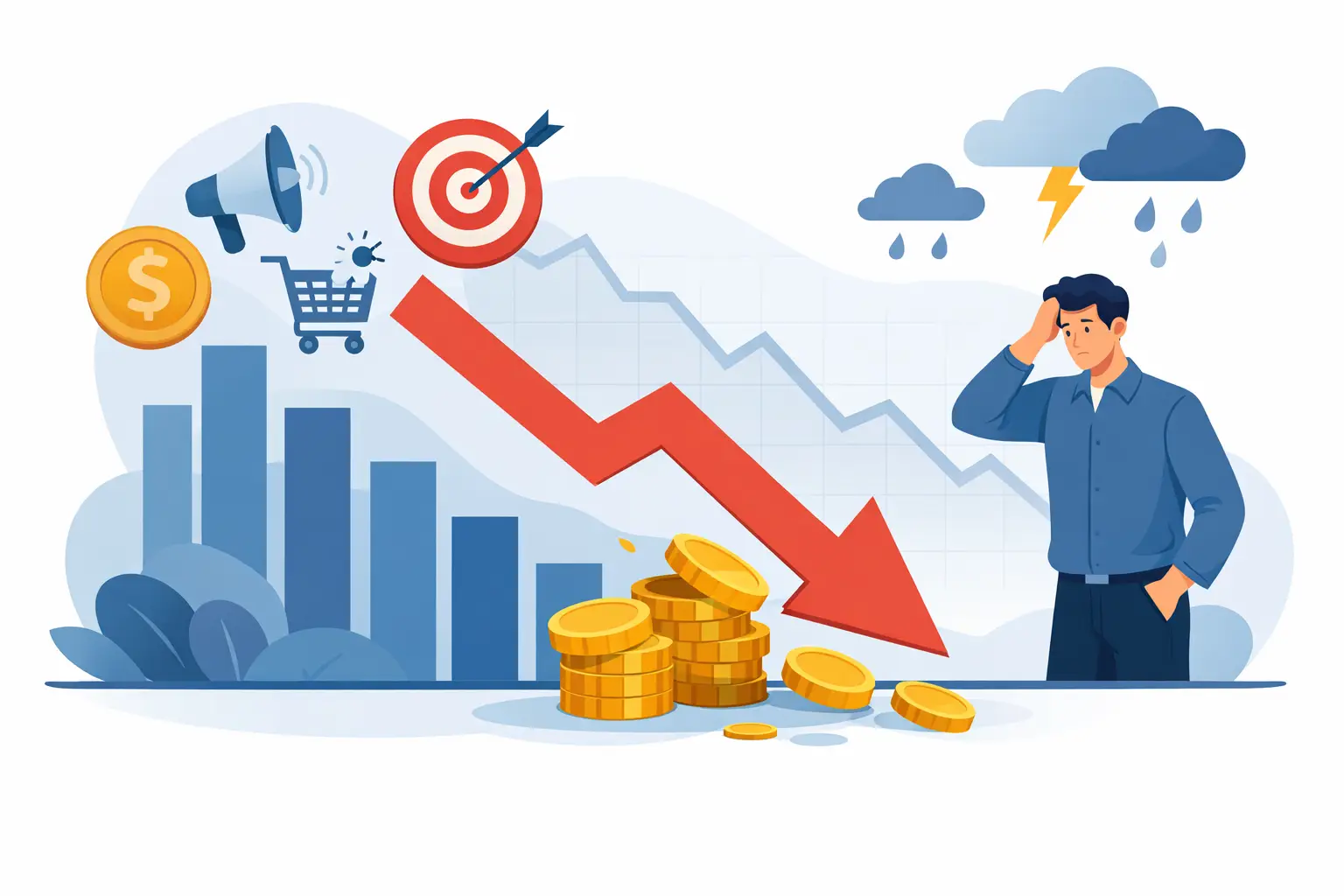
A campaign that held a 3.8x ROAS last week and slips to 1.9x this week usually feels like a platform problem. Sometimes it is. More often, the drop is coming from a specific break in the system – traffic quality, conversion rate, tracking, offer strength, or plain market pressure.
If you’re asking, why is my ROAS dropping suddenly, the right response is not to start changing everything at once. That usually makes diagnosis harder. ROAS drops are rarely random. They tend to come from one of a few predictable failure points, and each one leaves a different pattern in the data.
Why is my ROAS dropping suddenly? Start with the math
ROAS is a lagging output. It does not move on its own. It changes because one or more of the inputs changed first: cost per click, click-through rate, conversion rate, average order value, lead quality, close rate, or attribution.
That matters because many brands react to falling ROAS as if the ad account itself is broken. In reality, a ROAS decline is usually one of three things. You are paying more for the same result. You are getting the same traffic but converting less of it. Or your reporting is no longer measuring performance correctly.
Before you pause campaigns, isolate which of those is happening.
The fastest way to diagnose a sudden ROAS drop
Start with a short comparison window. Look at the last 7 days against the prior 7, then validate against a 14- or 30-day baseline so you do not overreact to normal volatility. This is especially important for lower-volume accounts, where one or two high-value purchases can distort the picture.
Then review the account in sequence.
First, check spend, impressions, CPM, CTR, CPC, conversion rate, and AOV. If CPMs jumped but CTR and conversion rate stayed stable, the issue is likely auction pressure or audience saturation. If CPC stayed flat but conversion rate fell, the problem is probably on-site, in the offer, or in lead quality. If platform-reported conversions dropped while backend revenue stayed steady, you may be looking at a tracking issue rather than a real demand issue.
This order matters. It keeps you from treating a measurement problem like a media buying problem.
Traffic got more expensive
One of the most common reasons ROAS falls suddenly is that your media costs rise faster than your account can absorb. On Meta and TikTok, this can happen during seasonal spikes, aggressive competitor activity, creative fatigue, or when campaign learning resets after a major edit. On Google, it can come from increased auction competition, broader match behavior, weaker search intent, or Performance Max shifting budget toward lower-efficiency inventory.
The mistake here is assuming higher costs always mean the campaign should be shut down. Sometimes the account is still healthy, but your margin for error narrowed. A brand with strong conversion rates and repeat purchase economics can tolerate temporary cost inflation. A tighter-margin business cannot.
If ROAS dropped because costs climbed, review whether frequency rose, CTR declined, and first-time impression ratio fell. That combination often signals creative fatigue or audience exhaustion. If search campaigns are responsible, review search term quality, impression share shifts, and whether budget is pushing you into less efficient auctions.
Conversion rate fell, even if traffic looks fine
This is where many brands lose time. The ads keep driving clicks, so the assumption is that media is doing its job. But if landing page conversion rate falls from 3.2% to 1.8%, ROAS will collapse even with stable CPCs.
The causes are usually operational. A product goes out of stock. Shipping times change. A discount expires. Site speed worsens after a theme update. A form breaks on mobile. A checkout app conflicts with another plugin. For service businesses, lead forms may still submit, but lead intent drops because messaging attracted the wrong audience.
This is why ad performance should be reviewed as a full-funnel system, not channel by channel. A sudden ROAS drop often starts outside the ad platform.
If your click metrics are stable but purchases or qualified leads fall, test the user journey yourself. Go from ad to landing page to checkout or inquiry submission. Check mobile first. Review page load times, add-to-cart rate, checkout completion, and any changes made by developers, merchandisers, or sales teams in the last 7 to 14 days.
Tracking broke, and the account only looks worse
Sometimes the revenue did not fall. The reporting did.
This is especially common after CMS updates, GTM changes, consent banner edits, GA4 configuration changes, domain issues, or payment processor adjustments. On Meta, missing or duplicated purchase events can distort optimization and reporting. On Google Ads, broken enhanced conversions or weak primary conversion settings can make campaigns look less efficient than they are. Server-side setups reduce some of this risk, but they still require monitoring.
If you’re wondering why is my ROAS dropping suddenly and the drop seems too sharp to be real, compare platform data against your store backend or CRM. If Shopify, WooCommerce, HubSpot, or your internal sales data shows stable revenue while ad platforms show a decline, treat attribution and event tracking as the first priority.
Do not optimize based on bad measurement. That compounds the problem.
Your offer got weaker relative to the market
Not every ROAS drop is technical. Sometimes your ads, site, and tracking are all working, but the market changed around you.
Competitors launched stronger promotions. Your pricing moved up. Economic pressure made buyers more cautious. Your creative no longer communicates enough urgency or differentiation. This shows up when traffic quality appears normal, but purchase rate softens and branded search or repeat buyer behavior stays stronger than cold traffic.
This is where performance marketing has limits. Media buying can improve efficiency, but it cannot force demand when the offer is less competitive. If the same audience once converted with a 10% discount and now stalls with no incentive, the issue may be commercial, not tactical.
That does not mean discounts are the only answer. Sometimes stronger bundles, better messaging, clearer proof, financing options, or tighter lead qualification drive better results without cutting margin.
Platform changes and account instability can trigger drops
There are cases where the platform itself contributes to volatility. Broad targeting expansion, attribution model updates, PMAX budget reallocation, audience overlap, or aggressive automation can produce short-term swings. Major budget increases can also destabilize performance if the account lacks enough conversion volume to support the change.
This is why structured testing matters. If five variables changed in three days – budget, creative, landing page, audience, and bid strategy – you cannot identify the root cause with confidence. Stable accounts are easier to fix because the data tells a clearer story.
In practice, sudden ROAS drops are often made worse by reactive account management. Teams panic, duplicate campaigns, reset learnings, cut budgets too hard, then wonder why recovery takes longer.
What to fix first when ROAS drops
Start with verification, not action. Confirm whether the drop is real in backend revenue or just visible in ad reporting. Then determine whether the issue is cost inflation, conversion loss, or tracking failure.
If costs rose sharply, reduce waste before reducing scale. Tighten placements if needed, refresh creative, review audience overlap, and check whether your budget is pushing into inefficient impressions. If conversion rate fell, audit the landing page, checkout, mobile experience, inventory status, and sales process. If tracking is broken, fix events and attribution before making major optimization decisions.
Only after that should you start restructuring campaigns.
There is also a trade-off to manage here. Not every drop requires an immediate rebuild. Some accounts experience normal variance, especially at lower spend levels or with higher-ticket products. A founder spending $2,000 a month cannot interpret data the same way as a brand spending $50,000 a month. Volume changes what counts as a signal.
The real question behind falling ROAS
Most teams ask, why is my ROAS dropping suddenly? The better question is, which part of the acquisition system changed first?
That framing leads to better decisions. ROAS is not a strategy. It is the output of your traffic, offer, funnel, tracking, and post-click experience working together. When one of those breaks, the number falls. When you identify the broken part quickly, recovery becomes operational instead of emotional.
This is also where disciplined account management separates reliable growth from guesswork. A structured review process, clear change logs, and full-funnel visibility will catch most of these issues before they turn into a month of wasted spend. That is the standard performance teams should be held to.
If your account has become inconsistent, the fix is rarely more activity. It is better diagnosis, cleaner testing, and tighter control over the full path from click to revenue. That is what restores profitable performance and keeps short-term drops from becoming long-term decline.
When ROAS falls, slow down just enough to find the real break. The brands that recover fastest are usually the ones that stop guessing first.