

You do not have a “marketing problem” when revenue is flat and ROAS swings week to week. You have a workflow problem.
Most e-commerce brands don’t lose because their creative is bad or their product is wrong. They lose because execution is inconsistent: ads launch without clean tracking, email goes out without segmented logic, SEO pages publish without a revenue plan, and reporting shows numbers but not decisions. If you are paying an agency, that inconsistency gets expensive fast.
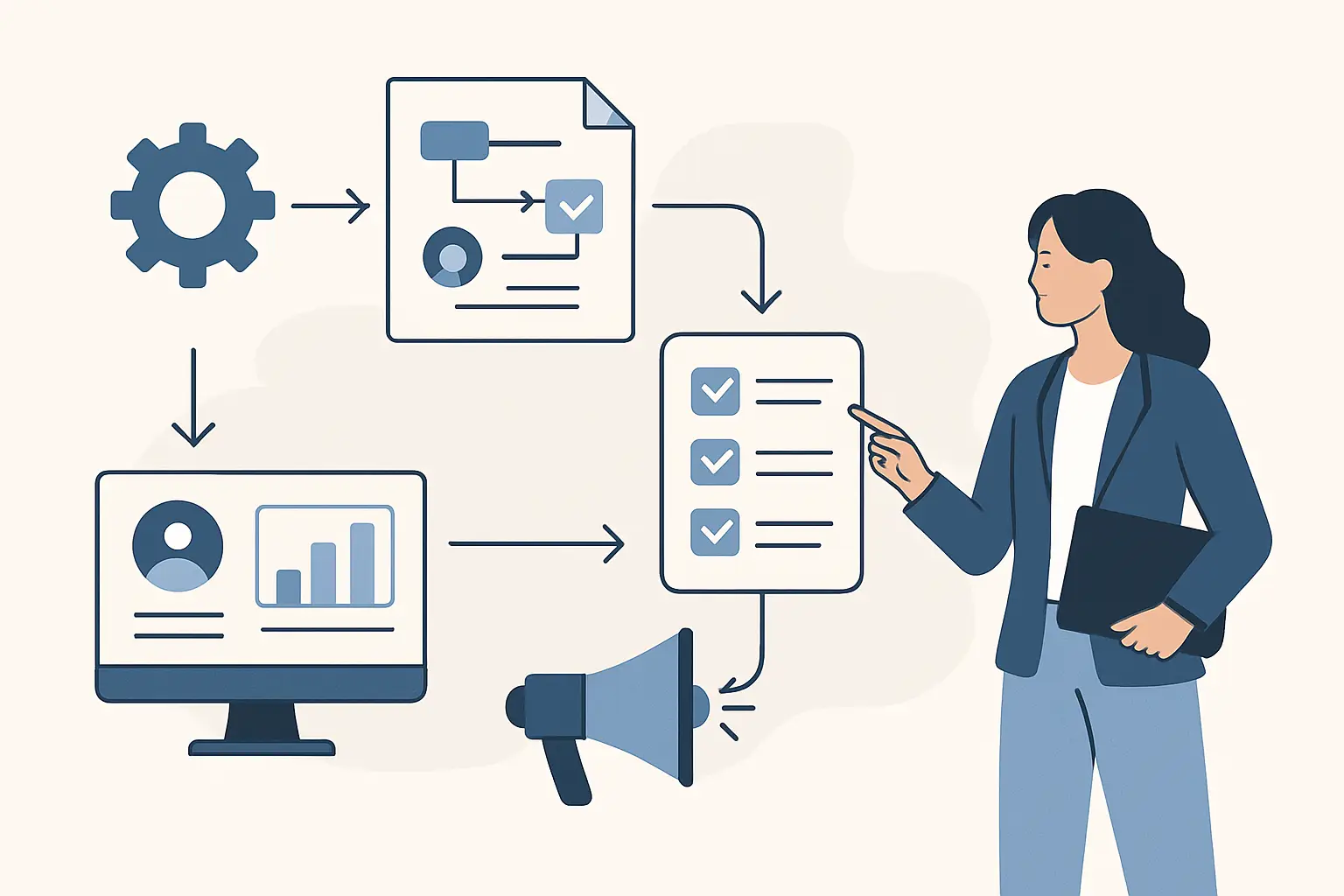
A step by step marketing workflow agency model fixes that by making performance repeatable. It sets expectations, assigns owners, defines what “done” means, and keeps every channel moving in the same direction.
What a step-by-step marketing workflow agency actually delivers
A real workflow is not a checklist someone references once. It is an operating system for growth. It tells you how strategy becomes execution, how execution becomes learning, and how learning becomes better performance next month.
For e-commerce brands, the workflow has to connect three things that often get managed separately: paid acquisition (Meta, Google, TikTok, LinkedIn), lifecycle email (often in Klaviyo), and SEO. The trade-off is that a structured workflow can feel slower in week one. In practice, it moves faster by week four because you stop rebuilding the plane mid-flight.
Step 1: Align on revenue targets and constraints
Before anyone touches an ad account, you need clarity on what you are solving for. “Grow sales” is not a target. A target is something like: increase new customer revenue by 20% in 90 days while holding blended MER above X, or improve contribution margin by reducing CAC on a specific product line.
Constraints matter just as much. Inventory limits, fulfillment speed, discount rules, brand positioning, and seasonality all shape what “good marketing” looks like. A disciplined agency will get those constraints in writing because they prevent bad optimizations later, like scaling a product that cannot ship on time or pushing a discount strategy that damages margins.
Step 2: Audit the current system, not just the channels
A channel audit alone misses the real leak. You want a system audit: tracking, product mix, landing page path, email capture, attribution expectations, and creative pipeline.
This is where hard truths show up. Sometimes Meta performance looks “bad” because the site is slow on mobile. Sometimes Google Search looks “expensive” because the offer is unclear above the fold. Sometimes email looks “weak” because the list is mostly unengaged and never cleaned.
If your agency cannot explain how each channel influences the others, you are going to get isolated wins and inconsistent revenue.
Step 3: Build measurement you can trust
Performance marketing without trusted measurement becomes opinion marketing. Your workflow should include a tracking and reporting setup phase that covers:
- Conversion tracking and event health (not just “installed,” but firing correctly)
- Source-of-truth revenue reporting (platform vs analytics vs backend)
- A naming convention for campaigns and tests so learnings are reusable
- Dashboard views that show decisions, not vanity metrics
It depends on your business how deep this goes. If you run high AOV with longer cycles, you may rely more on blended metrics and cohort behavior. If you run impulse buys, you can optimize more aggressively to shorter-window conversion data. Either way, the goal is the same: confidence that the numbers support the next decision.
Step 4: Define the channel roles and the customer journey
A step-by-step workflow agency approach maps each channel to a job, then designs handoffs.
Paid social is often strongest at demand creation and new customer volume. Google Search and Shopping tend to capture intent and convert efficiently when feeds and landing pages are tight. TikTok can generate low-cost reach and creative learning. LinkedIn matters when the product and buyer match the platform.
Email is the profit engine when it is built correctly – welcome, browse/cart abandonment, post-purchase, winback, and segmentation that reflects real buying behavior. SEO is the compounding asset that builds visibility and lowers reliance on paid media over time.
When these roles are clear, your workflow stops fighting itself. You do not judge SEO by week-one sales. You do not expect email to fix a broken acquisition offer. You stop “testing” random ideas and start running a plan.
Step 5: Turn strategy into a 30-60-90 day execution plan
Strategy only matters when it becomes a calendar. A reliable agency will convert the audit and channel roles into a phased plan with owners, deadlines, and acceptance criteria.
In the first 30 days, the focus is usually foundations: tracking, account structure cleanup, landing page priorities, and core automations in Klaviyo. Days 31-60 are for controlled scaling: creative testing cadence, new campaign builds, segmentation expansion, and SEO content or technical fixes that support revenue pages. Days 61-90 are for optimization and leverage: budget shifts based on performance, deeper funnel experiments, and content that strengthens organic rankings.
The trade-off here is discipline. If you chase every new idea immediately, you sacrifice learning. If you follow the plan, you build a baseline and improve from reality.
Step 6: Execute paid media with a testing cadence
Paid media success rarely comes from one “great campaign.” It comes from a system that launches, learns, and iterates weekly.
The workflow should separate creative testing from budget scaling. You test to discover what messages, angles, and formats generate qualified traffic and conversions. You scale only after you see repeatable performance.
A dependable process also includes platform-specific mechanics: Meta needs clean conversion signals and creative volume. Google needs feed quality, query control, and landing page relevance. YouTube needs a hook that earns attention, not just a brand video. TikTok needs native creative and fast iteration.
If your agency runs all platforms the same way, results will be inconsistent. Platform specialization is not a buzzword. It is what prevents you from wasting spend.
Step 7: Build lifecycle email to raise your floor
If paid performance dips, email should protect revenue. That is what “always-on” means.
A step-by-step workflow agency treats email as an owned channel with predictable levers: list growth, deliverability, automation coverage, segmentation, and campaign calendar. Your automations should not be generic templates. They should match your product, your buying cycle, and the objections people have before purchasing.
Segmentation is where most brands leave money on the table. New subscribers, first-time buyers, repeat buyers, high-AOV buyers, category purchasers, and lapsed customers all need different messages. When this is handled inside a documented workflow, you stop sending “one email to everyone” and start driving measurable retention.
Step 8: Run SEO like a revenue program, not a blog
SEO is often treated as content output. The workflow that performs treats it as demand capture and demand expansion.
That means starting with the pages that can produce revenue: category pages, collection pages, product pages, and high-intent supporting content that answers purchase-adjacent questions. Technical SEO matters, but it should be prioritized by impact. A faster site, cleaner indexing, and stronger internal linking often move the needle more than publishing 20 low-intent articles.
SEO is also where patience and accountability have to coexist. Rankings take time, but execution should not be vague. You can measure progress through index coverage, impressions for target queries, page-level engagement, and assisted conversions while the rankings mature.
Step 9: Creative and landing pages as part of the workflow
Performance does not live in ads alone. Creative and on-site experience are multipliers.
A strong agency workflow includes a repeatable creative intake process: what is performing, what objections need to be addressed, what offers are approved, and what formats are required per platform. It also includes landing page priorities tied to campaigns, not random redesign projects.
If you are scaling spend without improving the page experience, you are paying more for the same conversion rate. If you are redesigning pages without traffic strategy, you are polishing a room nobody enters.
Step 10: Weekly optimization and monthly decision-making
Optimization is not “tweaking.” It is structured decision-making.
Weekly, your agency should be looking at signal quality, spend allocation, creative fatigue, email revenue coverage, and SEO execution progress. Monthly, you should be making bigger calls: which product lines to push, whether to expand a channel, which offers are working, and what to build next.
Reporting should be tied to actions. If a report does not end in decisions – budgets shifted, tests launched, pages improved, automations added – it is not doing its job.
Step 11: Operational support that keeps performance steady
The hidden value of a step-by-step workflow agency is stability. Accounts break. Pixels misfire. Feeds get disapproved. Email domains drift into spam. A reliable partner builds operational support into the engagement so the machine keeps running.
This is also where accountability shows up. When a workflow is documented, you can see what is in progress, what is blocked, and what is shipping next. You are not guessing whether work is happening.
If you want a partner that runs this kind of disciplined delivery across paid ads, Klaviyo email, and SEO, Proline Web is built around a documented process and ongoing support designed to keep performance moving.
How to judge whether an agency workflow is real
You do not need to ask for a “secret sauce.” You need proof of operations.
A real workflow is visible in how quickly an agency can define targets, diagnose constraints, and produce a 30-60-90 plan. It is visible in naming conventions, QA steps, and how testing is logged. It is visible in how reporting leads to specific next actions. And it is visible in how the agency handles the unglamorous work: tracking fixes, feed issues, deliverability, and site performance.
If the agency cannot explain the handoff between channels, cannot show you how decisions are made, or cannot tell you what happens every week, the results will depend on luck.
A strong workflow will not guarantee that every month is up and to the right. Markets change, platforms shift, and products have seasons. What it guarantees is that you will not be guessing. You will be executing a system that learns, compounds, and protects your revenue while it grows.
Your next move is simple: insist on a workflow you can see, with decisions you can track, and with specialists who own outcomes end-to-end – because growth gets easier when your marketing runs like operations, not improvisation.