


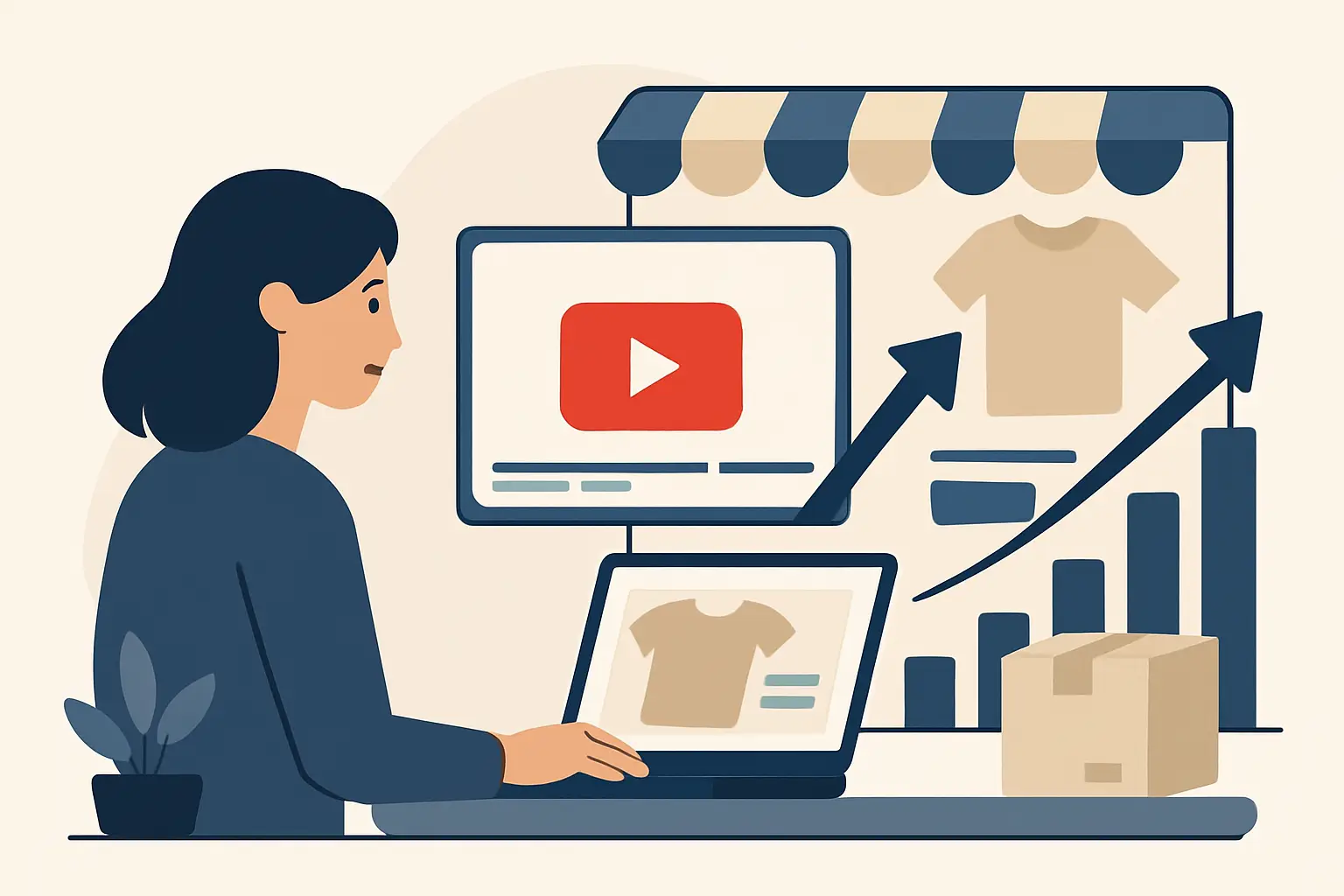
If your ecommerce store is stuck between “prospecting is too expensive” and “retargeting is tapped out,” YouTube is often the missing middle. It is one of the few platforms where you can create demand and then capture it later, without relying on a single feed ad to do all the work. But YouTube only performs when it is built like an operating system: the right objective, the right audience signals, the right creative structure, and measurement you can trust.
This is a practical guide to youtube ads for ecommerce brands that want scalable revenue, not “views,” and not a dashboard full of vanity metrics.
Why YouTube behaves differently than Meta or Search
YouTube sits in a unique position in the customer journey. It is not pure intent like Search, where the customer is already asking for a product. It is also not purely interruption-based like social, where you are trying to win attention in half a second.
On YouTube, people give you time, but they make decisions on their terms. That changes your job. Your job is to create clear buying context and then make it easy for the algorithm to find more people like the ones who convert.
The trade-off is that YouTube is rarely instant. If you are looking for day-one ROAS on cold traffic, you will be frustrated. If you are willing to build a repeatable acquisition engine with disciplined testing and conversion tracking, it can become one of the most dependable channels in your mix.
The account foundation that determines performance
Most “YouTube doesn’t work for us” stories are measurement stories. Before you touch creative or targeting, you need tracking that is stable enough to make decisions.
You want three things in place.
First, clean conversion tracking with Google Ads conversion actions aligned to real business outcomes. For ecommerce, that usually means purchase as primary, with add-to-cart or begin checkout as secondary only if you have enough volume and a clear plan for how you will use those signals.
Second, a product feed connected through Google Merchant Center if you plan to use video action campaigns with product feeds. This matters because it reduces friction: viewers can jump straight into products without you forcing a single landing page to do all the heavy lifting.
Third, consistent UTM discipline so your analytics and your ad platform are telling the same story. You do not need a complicated naming system, but you do need one that does not change every week.
If you are missing any of the above, optimization becomes guesswork, and YouTube is unforgiving when the feedback loop is broken.
Picking the right campaign type for ecommerce
Not every YouTube campaign is built to sell. Your goal is to start with what can drive purchases, then expand once the fundamentals are producing.
For most ecommerce brands, the best starting point is a conversion-focused video campaign that is designed to drive actions, not just views. You are telling Google: optimize toward people likely to buy, not people likely to watch.
From there, you have two common paths depending on your catalog and your margins.
If you have a broad catalog and want to show products dynamically, a setup that incorporates your product feed can help shorten the path to purchase.
If you have a tight hero SKU strategy, you will often get more control and faster learning by pushing one product at a time, with a dedicated landing page and a message that matches exactly what the shopper will see on site.
It depends on your store. Wide catalogs often need structure. Hero product brands need clarity.
Targeting on YouTube: stop over-segmenting
A common mistake is building dozens of tiny audiences because it “feels” precise. On YouTube, precision can backfire. You limit scale, you slow learning, and you force your creative to do the wrong job.
Instead, think in layers of intent.
At the top, you have broader reach that still has ecommerce relevance. This is where the algorithm learns and finds pockets of buyers.
In the middle, you have signals that suggest shopping behavior, such as people who have interacted with your site or engaged with your content.
At the bottom, you have high-intent retargeting: cart abandoners, product viewers, and past purchasers for upsells.
The operational approach that performs best is usually fewer campaigns with clear roles, not many campaigns with overlapping audiences. Overlap muddies reporting and makes it harder to know what is actually working.
Creative that converts on YouTube (without feeling like an ad)
YouTube creative fails for predictable reasons: slow openings, unclear offers, and videos designed for brand awareness trying to do performance marketing.
Performance creative on YouTube is structured. You earn attention quickly, you show the product in use, and you remove uncertainty.
Start with the first 5 seconds
The first 5 seconds decide whether you get a chance to sell. Lead with the outcome, the problem, or the transformation. Do not lead with your logo animation or a lifestyle montage.
If you sell a product that solves a clear problem, state it fast. If you sell a product that is about identity or taste, show it being chosen, worn, or used in a way that signals the buyer profile.
Demonstration beats description
Viewers trust what they can see. A simple product demo, a before-and-after, or a “here is exactly how it works” clip will often outperform a beautifully edited brand spot.
If your product is not visually obvious, use on-screen text and tight close-ups. Assume the viewer is not listening with sound on.
Handle objections like a sales team would
Good YouTube ads feel like a confident sales associate: clear, helpful, and specific.
Common objections you can address quickly include shipping time, return policy, durability, sizing, and what makes you different from a cheaper alternative. If you avoid these, your click might be cheap, but your conversion rate will suffer.
Match the landing page to the promise
If your video sells “all-day comfort” and the landing page is a generic collection page, you will pay for that mismatch. Your landing experience should mirror the ad’s message, show proof, and make the next step obvious.
Budgeting and bidding: what “enough data” really means
YouTube needs conversion volume to stabilize. If your budget only supports a handful of purchases per week, the system will struggle to learn and you will see volatility.
A practical rule is to aim for enough spend to generate consistent conversion data weekly. If you cannot support that yet, you can still run YouTube, but your expectations should shift: you are buying learning and audience building, not immediate efficiency.
On bidding, be careful with aggressive targets too early. If you set a target CPA or ROAS that is tighter than your account can realistically hit, you can choke delivery. A smarter approach is to start with a controlled learning phase, then tighten targets as performance stabilizes.
Measurement: what to watch (and what to ignore)
If you only look at ROAS, you will miss what YouTube is doing. If you only look at view metrics, you will overpay for attention.
You want a balanced set of indicators.
Watch purchase volume, cost per purchase, and contribution to new customer acquisition. Watch assisted impact through branded search and direct traffic trends, but treat those as supporting signals, not proof.
Be cautious with view-through conversions. They can be directionally useful, but they are not the same as a click-based purchase. If you let view-through numbers drive decisions, you will think every creative is a winner.
The most dependable approach is consistent conversion tracking, clean attribution windows, and a weekly reporting rhythm that separates prospecting performance from retargeting performance.
A simple operating cadence for optimization
YouTube gets expensive when it is managed like a one-time launch. It gets profitable when it is run like a system.
Weekly, review search term lift, audience performance at a high level, and creative engagement trends. You are looking for early warnings: falling click-through rate, rising cost per purchase, or frequency creeping up in retargeting.
Every two to four weeks, refresh or iterate creative. That does not always mean new shoots. Often it means new hooks, tighter edits, different objections addressed, and new proof assets such as reviews or UGC.
Monthly, validate that your measurement still matches reality. Ecommerce stores change fast: new themes, new checkout behavior, new apps. Small site changes can break tracking and quietly drain performance.
If you want this run end-to-end with a documented workflow and ongoing support, that is the kind of performance system we build at Proline Web.
When YouTube is not the right next move
YouTube is not a magic fix. If your offer is weak, your pricing is uncompetitive, or your site conversion rate is low, YouTube will amplify the problem by sending more people into a leaky funnel.
It can also be the wrong move if you do not have creative capacity. You do not need a studio, but you do need a steady stream of real product footage, customer proof, and new angles. Without that, you will hit creative fatigue and plateau.
If either of those are true, the better move is to tighten the fundamentals first, then add YouTube once your store can convert consistently.
The real advantage: compounding demand
The brands that win on YouTube treat it like a demand asset. You build familiarity, you educate the buyer, and you earn repeat exposures that make every other channel work harder. Search gets cheaper. Retargeting gets warmer. Email capture improves because people already trust you.
The helpful closing thought is this: run YouTube like an operating process, not a creative experiment. When you can measure purchases confidently and you keep creative iteration on schedule, YouTube stops being unpredictable and starts acting like a reliable growth channel you can plan around.