

The fastest way to make your ad account look “better” is to spend more.
The fastest way to make your business healthier is to make the traffic you already pay for convert at a higher rate.
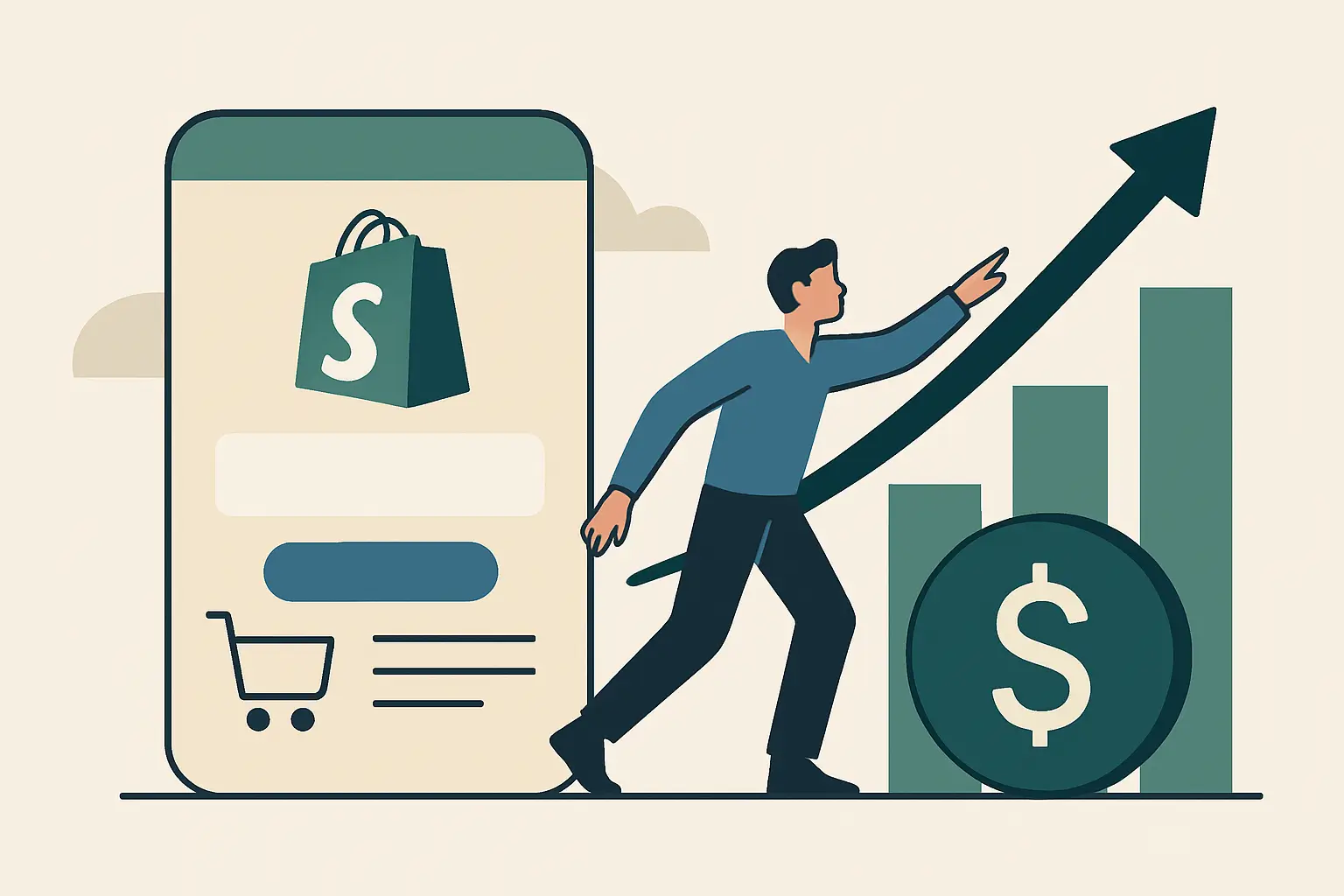
That is the job of Shopify conversion rate optimization services. Not redesigns for the sake of taste. Not random “best practices.” A structured system that finds the friction in your funnel, proves what fixes it, and compounds the lift across Meta, TikTok, Google, and email.
What Shopify conversion rate optimization services actually cover
CRO on Shopify is often treated like “website tweaks.” In reality, it is revenue engineering across your entire purchase path.
It starts with measurement – because if the tracking is wrong, every test result is a guess. Then it moves to diagnosis – where is revenue leaking, and why. Then it becomes execution – shipping changes that measurably increase conversion rate, profit per visitor, and customer lifetime value.
The scope should include your product pages, collection pages, cart, checkout, post-purchase flow, and the offers that sit behind the clicks. It should also include how paid traffic lands, what message match looks like, and whether your email and SMS flows are doing their part after the first session.
If a provider only talks about button colors and heatmaps, you are buying activity, not outcomes.
The metrics that matter (and the ones that mislead)
Conversion rate is the headline, but it is not the full scoreboard.
A “win” that lifts conversion rate while cutting average order value can still be a loss. A “win” that increases AOV by pushing aggressive bundles can look great until refund rates rise or repeat purchase drops.
Performance-driven CRO focuses on a small set of connected metrics: profit per visitor, contribution margin, checkout conversion rate, and new customer rate. It uses AOV and conversion rate as levers, not vanity goals.
This is also where it depends.
If you are an established brand with strong repeat purchase, you can justify lower front-end efficiency to acquire more customers. If you are cash-constrained, CRO should prioritize immediate payback and reduce wasted clicks first. The right Shopify CRO plan is built around your constraints, not someone else’s benchmark.
A structured CRO workflow that scales
Good CRO is a process, not a brainstorm. The workflow below is what separates predictable compounding from sporadic wins.
1) Tracking and data validation first
Before you test anything, you need clean inputs.
That means confirming GA4 and platform pixels are firing correctly, reconciling Shopify revenue with ad platform reporting, and validating events across devices. If you are scaling spend, server-side tracking and clean GTM implementation often become non-negotiable. Otherwise, you end up optimizing to partial data, and your winners don’t hold.
2) Funnel diagnosis based on evidence
Diagnosis uses both quantitative and qualitative data.
Quantitative: Where are users dropping? Are collection pages underperforming? Is cart-to-checkout conversion weak? Is checkout completion low relative to your category?
Qualitative: What objections are showing up in support tickets, reviews, and survey responses? What do returning customers say was the deciding factor? What friction shows up in session recordings?
The goal is to turn “maybe the page is confusing” into “users are failing to find size guidance and bouncing before adding to cart.” Specific problems create testable hypotheses.
3) Prioritization that respects effort and impact
You do not start with the hardest test.
A disciplined roadmap balances impact, confidence, and implementation time. Some of the highest ROI changes are not glamorous: fixing variant selection UX, tightening message match from ads to landing pages, clarifying shipping and returns above the fold, or restructuring collections to reduce choice overload.
4) Testing and iteration, not one-and-done changes
Testing is where many Shopify stores get stuck.
They either never run controlled tests, or they run tests without enough traffic and call noise a winner. A strong provider sets minimum sample thresholds, uses holdouts when needed, and avoids stacking multiple changes at once unless the goal is a packaged “page rebuild” with clear pre-post measurement.
When traffic volume is limited, you can still run effective CRO. You focus on high-signal areas like checkout, offer structure, and message clarity, then validate with time-based comparisons and segmented analysis. It is not perfect science, but it can still be disciplined.
5) Rollout and standardization
The point is not a single lift. The point is operational reliability.
When a test wins, it becomes a standard. It gets documented, deployed across relevant SKUs, and integrated into your creative and email messaging so the entire system benefits.
Where Shopify stores typically lose conversions
Most conversion issues fall into a few categories. Fixing them is not about “more persuasion.” It is about removing friction and making the purchase decision easier.
Offer clarity and message match
If your ads promise one thing and your landing page speaks to another, you pay for the click and then lose the session.
This shows up as high bounce rates from paid traffic, low add-to-cart rates, and inconsistent performance when you scale. CRO here often means rebuilding above-the-fold structure to mirror the ad angle, leading with the primary value proposition, and making the next step obvious.
Product page decision friction
Shopify product pages fail when they require too much thinking.
Common culprits are unclear sizing, missing shipping timelines, weak social proof placement, or a benefits section that reads like a spec sheet. The fix is usually structural: clearer hierarchy, tighter copy, better proof, and purchase helpers like FAQs and comparison guidance.
Collection and navigation problems
A lot of stores overinvest in product pages while ignoring the path that gets users there.
If your collections are not organized around how customers shop, you create choice overload. Paid traffic that lands on a collection page should be guided quickly to the right items with filters that work, sorting that makes sense, and merchandising that reflects your best sellers and margin priorities.
Cart and checkout leakage
Checkout is where you feel every unnecessary field.
Shopify’s checkout is strong, but stores still lose revenue through surprise shipping costs, unclear delivery windows, and limited payment options. CRO here can include shipping threshold testing, clearer delivery messaging earlier in the journey, and reducing distraction in cart.
You also need to watch incentives. Overusing discounts can raise conversion rate and quietly destroy contribution margin. Sometimes the right move is improving trust and clarity so you can reduce discount dependence.
CRO that connects to paid media and lifecycle
CRO should not live in a silo.
If you are scaling Meta, TikTok, or Google, your landing experience is part of your ad performance. Better conversion rate improves your ability to bid aggressively while staying profitable. It also stabilizes performance when CPMs rise or creative fatigue hits.
Lifecycle matters too. If email flows are weak, you rely on first-session conversion to carry revenue. Strong Shopify CRO services look at your browse abandonment, cart abandonment, and post-purchase sequences because they change the effective conversion rate of your paid traffic.
For some brands, the biggest lift comes from improving the entire purchase loop: a clearer first purchase offer, a tighter post-purchase upsell, and smarter replenishment messaging. That is not “email marketing” or “CRO” – it is one revenue system.
What to expect from a CRO services partner
You are hiring for accountability and repeatability.
A reliable partner will give you a testing roadmap tied to business goals, not vague ideas. You should see clear reporting that links changes to revenue impact and explains what was learned, even when a test fails.
You should also expect trade-offs to be discussed openly. A more aggressive bundle strategy can lift AOV but may reduce conversion rate. Removing friction can lift conversion rate but might reduce email capture. A strong CRO provider frames these decisions in terms of profit and payback period, not personal preference.
And you should not accept “we’ll optimize your Shopify store” without specifics on implementation. Who builds the changes? How fast? What is the QA process? How are changes rolled back if performance drops? CRO is only as good as the execution model behind it.
When Shopify conversion rate optimization services are worth it
CRO becomes a priority when you have meaningful traffic and a reason to believe you are leaving money on the table.
If you are already spending on ads and you see volatility, CRO stabilizes your unit economics. If you are preparing to scale, CRO increases the ceiling before spend gets expensive. If you have a solid product but inconsistent conversion, CRO is often the fastest path to more revenue without increasing acquisition costs.
If you have low traffic and no product-market fit, CRO will not save you. At that stage, you need offer validation and demand generation first. CRO can support, but it cannot replace a product people want.
A simple way to evaluate your current funnel
Look at your store the way your paid traffic experiences it.
Pick one top-performing ad and click through as if you were a new customer. Do you immediately see what the product does, who it is for, and why it is worth the price? Can you find shipping and returns without hunting? Does the cart surprise you with costs? Does the checkout feel trustworthy and fast?
Then compare that experience to your data. If your add-to-cart rate is fine but checkout completion is weak, you have a different problem than a store with high bounce and low product engagement. CRO is not one playbook. It is targeted fixes based on where the funnel breaks.
If you want Shopify conversion rate optimization services that run as a disciplined growth system – with structured testing, advanced tracking, and full-funnel accountability – Proline Web is built for that kind of work at https://prolineweb.com.
The closing thought to keep in mind: scaling ads is easier when your store does its job. The more predictable your conversion system is, the more confidently you can buy traffic and turn it into profit.
